Opt Out of Testing: Do We Dare to Bubble Dot That?

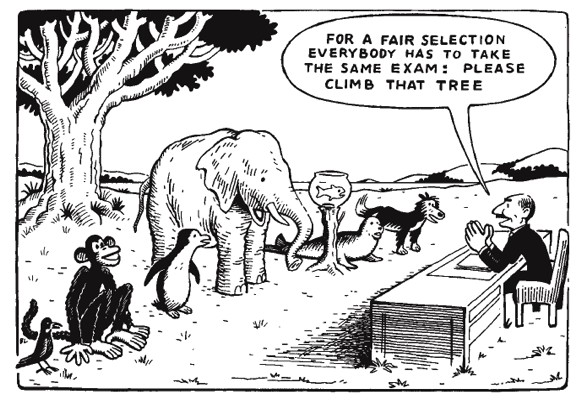
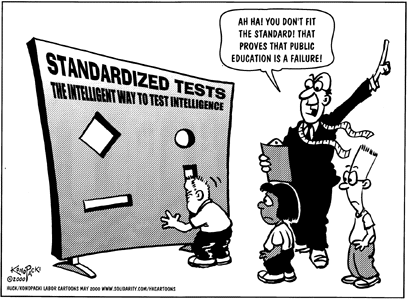
Well, the time has come for me to unleash the beast inside and ask you to look at, for yourself, your kids and your community the idea of opting out of High Stakes Testing.  Up until last week I have steered clear of writing about The Common Core State Standards and the test that will follow and how I have seen the rise of testing in our schools over the past 11 years (thank you No Child Left Behind)  has actually undermined and even damaged the education students are receiving by attempting to create a “one size fits all” mentality and leaving systems, professionals and teachers feeling they “MUST” teach to the test. Period.

one_size_fits_all_sticker-p217558662557834777en8ct_325

Recently Frontline asked three educational reform leaders including Diane Ravitch, Margaret Spellings and Geoffrey Canada  to watch and then speak back to The Education of Michelle Rhee, former chancellor of the DC public schools and a highly controversial figure in educational reform.

http://www.pbs.org/wgbh/pages/frontline/education/education-of-michelle-rhee/how-do-you-measure-success-in-school-reform/#seg3

Margaret Spellings, former US Secretary of Education under George W. Bush and one of the architects of No Child Left Behind writes in response to Rhee’s work and the upcoming onslaught of the Common Core,

“But I still argue that NCLB’s ambition remains pretty modest – all children performing at grade level in reading and mathematics – the bare minimum any of us would want for our own children or grandchildren. And while having every student meet the new Common Core standards is a laudable goal for DCPS and all the states now pursuing “college and career readiness,” it is an empty promise if they’ve yet to meet NCLB’s more modest goals.”

And I shudder to think that if a proponent of No Child Left Behind believes that even those goals were moderate then perhaps what lies ahead may be more daunting that we even realize.

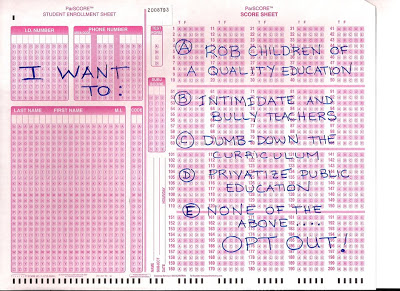
none of the above

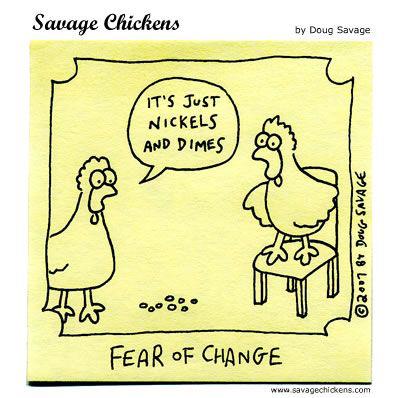
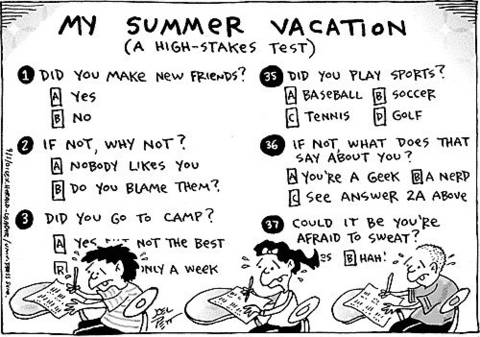
The question is do we dare?  Do we dare go against the norm or is the fear of change and going against the norm too much to risk?  Do we fear that by taking our own kids out of the testing world that it will somehow put them in a place of less importance than those who do test?  Will it limit their options in terms of lifelong goals, colleges and careers?  Without “measuring” our kids and putting them into little boxes will they become less significant in this world?  Without their numbers pasted on their backs will they matter as much as those with numbers or even more importantly those with the highest numbers?

734787_10151059810779649_1253315865_n

What does it mean to opt out?  Opting out is defined by United Opt Out National, in three phases, the first of which is to change the public narrative that testing is good.   These are the questions I am attempting to raise here.  The second is to break the cycle of complicity, isolation, coercion and the third is to support alternatives through knowledge, collaboration and trust in the power of collaboration.  I do believe that if we come together we can make a difference.  For more details about opting out…

Check out this site that talks about what it means to opt out and how we can band together to do so.  http://unitedoptout.com/flyers/what-does-it-mean-to-opt-out-2/

Or watch this video by Peggy Robertson, one of the founders of opt out, http://www.youtube.com/watch?v=_bJlbkxnDVU where she and her two boys reach out to Diane Ravitch,historian of education at New York University and expert on school reform to join them in the national opt out campaign in DC this coming April 4 – 7 where we will unite to protest against testing.  I am considering making this journey and would love to have others I know come with me or meet me there!!  You interested?  Here are more details.

http://unitedoptout.com/update-for-occupy-doe-2-0-the-battle-for-public-schools/

OptOut

So it is time for action.  Enough kavetching about it…it is time for action and trusting in the process of collaboration and the idea that if we band together we can make change happen.  REAL change for all of our kids.

What do you think?

Do we dare?

The Not So Common Core Standards: Potential Implications and Meaning For Us All

We live in a country that was founded on differences.  As I write this, I recall images of Felix Baumgartner free falling out of a hot air balloon from space.  We value this ingenuity, this creativity, this originality, this risk-taking. We live in the land of the free and yet everywhere you look, particularly in public education, it would seem we have collectively handed over our freedom in the name of compliance, consistency and the oh so not “common”, known as The Common Core.

Image

The powerful noblemen have doled out their marching orders to us, the commoners and we had better comply or beware.  David Coleman and Susan Pimenthal, co-authors of the Common Core Standards, are not educators.  They have not spent time in classrooms on the front lines and yet they have determined the core, the central, innermost, or most essential part of education.  So the question is…what does this mean for the public education of our students, your kids, my kids and those of the future?

The Common Core Standards document initially reads as somewhat benign.  Who would argue the idea that there “should” be a core of standards that all students in this great nation strive for?  (Although I tend to avoid “shoulding”on myself at all costs)  How could one oppose standards, ensuring success for all students?  (I mean if over 40 states adopted this then it must be great.)   Who would dare even oppose such a notion?  (And if you do oppose then what is wrong with you to be such a “curmudgeon” or a “whiner”.)  At the risk of being both I will go on.

Image

Read this kindergarten standard keeping in mind many 5 year olds show up to school and they do not even know their letters and they are beginning to lose their baby teeth.   For some they have never even attended preschool and this is their first school experience.  They are filled with wonder, curiosity, creativity and a natural desire to learn.

CCSS.ELA-Literacy.W.K.1 Use a combination of drawing, dictating, and writing to compose opinion pieces in which they tell a reader the topic or the name of the book they are writing about and state an opinion or preference about the topic or book (e.g., My favorite book is…).

I would argue that this is a more realistic standard for our 1st or 2nd graders.  Do we want our students to succeed or do we want to set standards that are so out of their range of normal development that they fail even before they begin?

And while I realize there ARE 5 year olds all over the nation who are more than capable of performing this standard, there are just as many who are not.  There is nothing magical about being 5 that means you are as developed as the other 5 year olds sitting next to you, not to mention that our boys are typically at least 6 months behind our girls.  And if this standard was something to look at in terms of a goal to work towards, I would have no problem with it, but it will not.  It will be seen as what is expected as “common” for all students.  We are starting out leaving over half of our kids behind.

There is no such thing as kindergarten anymore with these standards.  Sorry kids, no time to learn your letters, learn through play and be 5 years old as the standards expect you to show up to school reading informational texts closely and writing persuasive essays already.  Put away the sand tables and the blocks and the dramatic play areas there is work to be done.  And this begs the question, why are we so concerned with the academic side of the child without including the social and emotional sides?  They all work in connection with each other and without each given it’s due the scales are tipped toward disaster.

Image

The Common Core standards alone are not  bad.  In fact, in my work with schools there are great conversations that are happening as a result of this document as it asks us to look at where we are and what we are doing and what areas we need to improve on.  This is all good reflective practice and if it started and ended there…we would be able to say to ourselves, “This too shall pass”.  But will it?  Never before in public education has there been such a broad sweeping, nationally accepted document.  And while states all over the nation are adopting this document, two groups are being paid millions of dollars to come up with the best assessments (See PARCC (http://www.parcconline.org/achieving-common-core) and Smarter Balanced at (http://www.smarterbalanced.org/)).

Image

And therein lies the rub.  The high stakes testing piece to this latest “one size fits all” movement will come out in the year 2014 and I am predicting that at this point everything will change.  Schools all over the nation will be failing these tests and large publishing companies will be at their doors with the next magic bullet that will “solve” all testing deficiencies.  Have we learned nothing from No Child Left Behind?  The idea of “teaching to the test” will take on more power and energy than ever.

Image

This is not about good education.  This is not about educating our kids.  This is about making money and in order for that to happen we must first create an enormous problem.  Failure is the best reason for anyone to buy anything!  Overweight?  Buy this pill or that diet.  Failing schools?  Don’t leave it up the professionals within the schools to figure out what they need, because publishers know so much more. Students?  Who are they?

Image

We need to return to conversations about our students and what is or is not developmentally appropriate, what our students need for instruction in the moment based on their thinking, their questions and how they see the world.  Would you ever take an infant and force them to “walk” down the stairs?  NO!  But physical development is something concrete.  Cognitive development, on the other hand, is harder to understand and yet we forge ahead with the idea that if we place unrealistic expectations on our students then they will just rise.

They will not rise unless they are ready to rise!!  Those who are not ready will fall and hurdle  to the bottom of the stairs with nobody with be there to pick them up as there is a test to teach to and quite frankly, “I don’t give a  sh!t what you think or feel.”  This is a quote from David Coleman, one of 2 co-authors of the Common Core.   He has also taken on the position as head of The College Board 2 months ago.  This organization has more power over the future of all of our students and now this man will also align the SAT’s and test preps with ‘HIS” common core.  There is even talk of test scores being attached to kids GPA’s.  Can you say conflict of interest?

Image

Why and how, I must ask, have we allowed one elitist man from Harvard to have so much power over our entire system?    A man, who only cares about what he thinks.  Watch him as he demonstrates his version of a close reading on YouTube (http://www.youtube.com/watch?v=aTCiQVCpdQc) with A Letter From Birmingham Jail.  Or don’t, unless you really need a nap!  THIS is the future model for good teaching?  He is completely in his own head and unaware of his audience.  This demonstration both scares and depresses me.

And yet, why is it that those of us in education are the first ones to jump on to any wagon that happens to be going by, regardless of what band is playing?  Where has our responsibility to question gone?  Why are we not asking about what band is playing?   Why are we blindly following the pack? Let’s question what is happening here before it is too late.  Let’s take a risk, jump out of that balloon and take the plunge toward thinking and questioning what this means for our kids, our teachers and the future of our entire public educational system.

PS In my next post I will discuss some ways we can become actively involved as I discuss opting out of testing and events we can attend to show our support.

The Things We Carry

Zachary,  came home from high school one day with three poems chosen by his English teacher to “figure out”.  The assignment was to decide what “kinds” of poems they were and to look further to figure out what “literary devices” were used.

He came to me.  “Mom what kinds of poems are these?”

And the teacher in me responds to his question with a question.

“Well, what kinds of poems are you learning about?”

“None.”

“Well, haven’t you been looking at different kinds of poems in class and identifying them and what makes that what they are?”

“No.  MOM, we were just given these poems and told to find the literary devices.  This is what I have to do.  Can you just tell me?”

And so I look at the poems and instantly realize that even for me, these poems could fall into several categories.  So I tell him I am not sure.  Again I ask to see the poetry and begin to slowly look at them with him one at a time while asking him questions about what he notices in terms of how the poem is written, thus a way to discover “literary devices”.  In my head I am wondering, as well, just what this teacher is asking for and in this process I am removed from the poetry myself in an effort to “please” the teacher.  I too have fallen into school mode right alongside Zachary.

“That is NOT what the teacher wants Mom.  She just wants me to know what kinds of poems these are and what devices are used.  Mom, she doesn’t teach.  She just gives us assignments.”

“Well, what kinds of “literary devices” have you  looked at in other poetry or forms of writing?”

“None Mom, can you just help me get this done?”

“Well, how are you supposed to know if nobody every showed you.  Let me help you with this…”

If you are a parent then you know that teaching your own children is akin to trying to grocery shop with a group of young goats in tow.  Oil and water I say.

He stomps off  to spark notes and google to try to figure out what I cannot tell him and what he does not know because there has been no “model” in terms of what to look for.  These beautiful poems are reduced down to a hunt and peck on the internet in an attempt to figure out and “do” whatever it is the teacher has asked him to do.  There is no meaning.  There is no connection.  There is only the sense that he wants to get this done and done quickly and hopefully, somehow in the process he has figured out whatever it is the teacher is asking for at the same time.

download

Pushing my extreme frustration aside, I reflect on this conversation and realize his teacher is not modeling for him.  That the missing piece is and may always be that we are not “showing” our students what it is we are looking for.    In my work with teachers I often hear about how students are just not “getting it” and in this statement is a sense of blame.  They are frustrated with the students because they don’t know what they already know and the blame game begins. And yet, if nobody has ever taught or shown then how is the student supposed to know?  As an educator of students of all ages from kindergarten to adults, if a student is not understanding I have to ask myself what is my responsibility in all of this?

When a student is not understanding I have to stop and ask myself,

  1. What is it that they do not understand and why?
  2. What is it that I have not “shown”?
  3. Is there another way that I could model this for them?
download (2)

And although it sounds simple, it can transform your teaching.  This “in the moment” reflection allows us to connect with our students and to consider what they are learning from their point of view.  In doing this we begin to form a connection with our students and view them not as the object of blame, but as a human being to connect with, to teach, to show, to model for.  And once this connection has been made it lays the groundwork for further teaching.  These connections can also reach across the classroom as we identify models in others that are in the classroom as well.  Modeling is about “noticing” and naming what it is that we notice.  In this our students can then see that they too can notice and name.

Toting Libba Moore Grey’s, My Momma Had a Dancin’ Heart, under my arm, I enter Emily Spear’s wonderful and familiar first grade classroom where I am greeted with hugs and an offer for one of those famous birthday cupcake that are handed to you with great love and grey grubby hands.  I receive the confection’s love, knowing it will never get eaten and smiling at the gesture.

download (3)

I settle into the comfy rocker and take a brief time to reconnect as they tell me about their latest ventures in writing. Voices ring all around me as they share their latest “sound” words, onomatopoeia  the craft we worked on last time I was in.    Three little girls get closer, asking about the pink necklace I am wearing, twirling it in their hands and marveling at its sparkle.

Taking this time to reconnect with these kids is a critical part of the teaching process.  It only takes a few minutes, but in that time my words and actions show them I am interested in THEM.  This gives me an advantage because I have re-established our working relationship and ideally trust and can then move into our writing time together.

I read aloud, knowing that I want to model Moore’s use of playfully hyphenated words as a craft the kids could name and experiment with.  I stop and write some examples on the white board:

tip-tapping

song-singing

finger-snapping

We talk about these words and wonder why the author would use the hyphen.  They quickly identify that it makes it into one word, makes the reader say the word more quickly and creates rhythm.

We then brainstorm a name for these words and the list consists of

1.describing words

2. two words in one

3. DASH-ing words.

It is democratically decided that DASH-ing words describe them most accurately because of the dash (hyphen) and use of the suffix ”ing” on the end of each word.  Next, I ask them to go and try out some of the DASH-ing words in their own writing.

I first check in with Morgan, who seems to be struggling because she is not writing.  Her hands are poised under her chin and her page remains blank.  I sit to talk with her.  I am wondering what is keeping her from writing.  I ask her questions, but she just sits and looks up.  Finally I ask if she just needs some time to which she responds, “Yea.”  I leave and tell her I will check back with her.  In my mind I am wondering if I am copping out because it was a flat and uninteresting conversation.  I secretly hope that my decision to leave her and trust her is one that will work, but I never really know.  What I do know is that was I was doing was not moving her along and so I make the choice to let her work on her own.
download (4)

I move over to Nick, who also seems to be staring off into space.  I ask him how he is doing.  He responds, “I don’t know what to write.”   In my head I am asking, what does he not understand?  After a brief conversation I realize he does not understand what I had just modeled and that he needs further modeling.  I am not upset that he is not working, I am curious about why he is not.  I ask myself what is missing for him and what can I do to help this young writer to move forward?  What else can I model for him?  Is there another way in?   I lead him back over to the white board and we leaf through the book again looking at the DASH-ing words.  We finally realize together that he does not know how to start making his own word because it is not clear that the first word is often an object, a noun.  And so I model another example asking him to name an object.  He says pencil and I ask what a pencil might do.  He responds that it writes.  We work together and make it into pencil-scribbling because he liked that better than pencil-writing.

For others the playful word combinations take on a life of their own.  Some kids come up with what we call Double DASH-ing Words” such as tweet-tweet-tweeting.  Others begin lists and when I check back in with Morgan I realize that what was missing for her in that moment was think time.  (phew!) She shares this poem with the class, telling us that she chose to write a poem because the book was like a poem.

Swish-swash

Slush-sliding

Icicles-banging

Against the long

White world

But the world

Is not always white

Wow!  I just love the image of the long white world…

We all reconvened back to the carpet, shared our DASH-ing words and created a chart with all of the examples the kids had come up with, creating a classroom “model” that they could refer back to and add to.

I left the room, again humbled at the brilliance of these kids and just what they can do if given the time, space, place and a strong model of what is expected of them and in many instances, more modeling to help them move along in their writing.

In my work with these first graders and all of the students and teachers I work with as an instructor in the English Department at the University of New Hampshire’s Learning Through Teaching professional development program, I ooze passion for words and I do this on purpose.  I talk about what I read, write and wonder.  I show them first hand that literacy is not about school, it is about life and how we choose to live this life. I have my Writer’s Notebook and other sundry of books with me.  It could be a couple of children’s picture books, the current novel I am reading, or more recently my ipad.   Kids ask me about the ever-present essentials (appendages?) that I carry with me.  They are curious and I can open them up and share small pieces of myself with them.  It is an entry point for conversations about reading and writing.

When students see that we, as their teachers are interested in writing, reading books, articles, blogs, on-line periodicals, newspapers etc., they can “see” how we live each literate day.  When we talk about a great book we found at a used bookstore or bring in our favorite children’s book, they can catch a glimpse of our lives beyond the four walls of school.  And they begin to consider theirs as well.  We model every day with our words, out behaviors and even what we carry.
download (5)

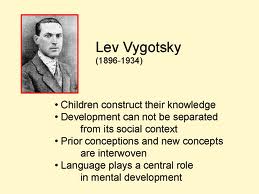
“There is a world in a word,” Lev Vygotsky wrote and it’s up to us to open up those worlds, and I am constantly thinking of new ways to open up those worlds, modeling at every step, whether that shows in what I carry with me, the conversations I have, I am the walking, talking lover of words and my students know this.

What do your students know about you and what do you model every day ?

Too Close To Home

There is something about location that makes everything that much more real.  When 9/11 happened, I had to drive my daughter into Boston for chemotherapy the next day.  Never before have I seen a city so hauntingly empty.  Armageddon had arrived. Eerily there was not anyone on the streets, the roads or out walking.  It was silent.  It was surreal and there is no other reason in the world I would have driven into a major city, except to save my baby’s life.  There was a schedule to hold and this was not going to stop us.

Being there was even more frightening than I had anticipated.  Nestled up in the 17th floor of Mass General I could see vigils going on below.  I sat in our glass high rise with my eyes glued to the TV, watching and waiting to see just what would happen next.

On the third day Emma looked out the window and screamed in fear ,”Momma look, a plane!!”.   I believe it was a military plane.  Somehow we had gotten used to the empty skies.  Planes had always been a past time for us at the hospital as we would go to the corner lounge or what we deemed, the “Looking Room” because it was all glass on two sides facing Logan airport.  We would sit and count planes and make guesses about how many we would see.  But, a plane was no longer a plane anymore, but a flying bomb.

Nothing looked the same. Nothing felt the same.  My mind never stopped and my heart never ached so much.

Nothing made sense anymore…my baby had leukemia and the World Trade Center has been attacked.  Chaos seemed to be the winner in all of this and fear was right behind it urging it on.

And then you fast forward to sitting in a movie theater watching the Dark Night and thinking about what that must have been like for those unsuspecting moviegoers.  There was so much gunfire and loudness in that movie that I bet some were actually unaware of what was even happening…thinking it was part of the movie.  I remember wanting to leave as I felt the spirits of those departed agonizing over how unfair it was to simply go to a movie and then end up never going home.  You realize…it could have been me or my son or you or anyone.

And then this…our schools.  Those little faces.  The sheer terror of those professionals realizing  the practice of lockdown drills and a reality that should never ever come to pass.  But it did.  And in that there are heroes.  Those teachers who put their students above themselves in the “line of duty”.  And I think, what would I have done?  What would you have done?

And so each time I walk into a school I have a new awareness of just how vulnerable those schools are…how vulnerable we all are really.  No measure of security is going to stop that kind of insanity.  And that is what it is…once again something that you just can’t make any sense of.  Something that gnaws at your insides and keeps you up at night.    Something that I spent 10 years of my life working against…the loss of a child.   But teachers all over the country went back into their classrooms on Tuesday and Wednesday and Thursday and Friday and will return to the battlegrounds, yet again on Monday.  And what do we do to thank these people?

Let’s remember that we have amazing people out there working with our kids every day…and yes, we have all had that teacher that should have retired years ago and those who should never have been in the classroom to begin with…and we all know who they are, but more than that we have people who have devoted their lives to kids.  It is a great time to sing to the unsung hero.  Thank you child’s teacher today.  Respect what they do and perhaps this is a calling to us all to “see” our kids as human beings where we need to teach empathy and collaboration and allow for creative and artistic expression and that in the big picture standardized tests are completely meaningless.

And in this moment how do we begin to come to terms and ever feel safe again when small children in public schools are being attacked?  How do we reach out and hold those parents who lost their most dear and treasured thing in the world?  I cannot even begin to fathom what those mothers and fathers and sisters and brothers and grandparents and aunts and uncles and teachers and janitors and secretaries and nurses and other children are going through…

They have all realized our greatest fear and this strikes us all in a way that is inconceivable.   We will never be the same.

Brick by Brick

I must confess.  I have been trying to write a book on education for years.  I have actually even put together what “looks” like a book, but if I am completely honest it sucks.  I love to write.  I love to write to discover what I am thinking or wondering about.  I love to play with words.  I love to write but I do not like the voice I put on when I am in book writing mode.  Why?

It dawned on me this morning that I hate what I have written in these books because as soon as I start to write something for the book I put on my slick persuasion blazer and bowler hat and begin the song and dance to show you my “expertise” in teaching and the classroom.  I become the evangelical used car salesperson of education.  I  try to cover everything that I know in order to create the be all and end all, the educational Bible of the century…and ultimately it is a massive failure.  In it I lose my truth, my voice, the essence of who I am which is not an expert of anything, but someone who thinks and wonders and reflects…alongside those I work with.

Image

So, how can I ask you to come along with me as I shed the slick suit with all the answers and indulge me in some way?  I have so many questions that I would like to explore and yet all of them seem are rooted in the theme of how to make our teaching and our classrooms authentic places where learning can and does happen.  How can we engage students instead of disengage them?   How can we change an entire system?  We can’t.  But perhaps what we can do is shift our thinking about our students, our classrooms, and the systems and begin to view them through a narrative lens.  What are the stories in your classroom?  What are the stories of those students you work with?  What are the stories in your literary life?

Research tells us that 70% of what we learn and remember is through a narrative form and yet 98% of the information we provide to our students is in the form of straight fact.

Elizabeth is a beautiful 7th grade soul struggling with a major disconnect between her Social Studies textbook and her sense of wanting to know and understand.  When I first worked with Elizabeth she took me up to her room and showed me her bookcase and all of the different books she liked to read.  She talked openly and freely and with great fluidity about who she was as a reader, what she liked, what she didn’t like and she laughed as we talked about “fake reading” and how she does it in school and so do all of her friends.  She was animated and those beautiful brown eyes danced with enthusiasm and purpose.

Fast forward to the dining room table 10 minutes later where Elizabeth and I will attempt to tackle her Social Studies homework for the night.  Her shoulders slump as she leans over and pulls out the Mount Everest of Textbooks.  It must weigh at least 5 pounds and it is only one of the many texts that Elizabeth is being asked to shoulder.  She lets it thunk down on the table and the reverberations from that book shudder across the table.  This is a heavy book, filled with endless information and Elizabeth’s long sigh confirms that the drudgery is about to begin.  First I ask her to tell me about the book.  She stops and thinks.  I wait.  I ask her what it feels like to read this book.  She thinks and eventually responds, “It is like reading a brick wall.  I try and I try but it is like I can never get through it.”  I am stunned and rendered speechless at Elizabeth’s ability to create such a powerful image for what this experience is like for her.  She is a deep thinker.  She likes to make sense of her world through simile and metaphor and I am in awe of her brilliance and so I tell her so.  She does not feel this way about herself, however.

Image

And we then begrudgingly open the monster of a book and begin.  She is reading about Russia.  Ahhh…yes Russia I begin to remember as both of my kids went through 7th grade with this same teacher and her passion for all things Russian in just one year.  The page she opens to is busy with color and information galore.  It is a smattering of information intended to inform, but to me it looks as though someone vomited everything they may or might want to cover in a chapter onto the page.

We begin with the title and I talk to Elizabeth about making these titles into questions.  Her eyes brighten.  She likes that there is something she can actually “do” to begin to make sense of the text in front of her.  We peruse the page and I move her to the bright green box at the left labeled major concepts and key vocabulary in an effort to activate schema and perhaps do some front-loading to guide her through the reading.

We get through one concept and as I try to conjure up as much information as I can about Russia I quickly realize I am as schema depleted as she is. We press on to vocabulary keeping the key ideas in mind as a purpose for our reading…should we actually get to the reading part.  There are 5 words and in each of those words lives worlds of information.  Elizabeth wants to know more.  What is a Czar?  How is that different than a president?  She is inquisitive, engaged and interested.  A half an our of our time has passed and we have yet to actually even “read” anything!  I move us along…feeling the time crushing in on us.

Image

We start with our questions to read with a purpose and not three words into her reading there is a vocabulary word that she is stumbling over.  She looks up at me and I continue on to the end of the paragraph. I ask her if she understands what she is reading. She shakes her head no.  We talk about stopping and thinking about her understanding and stopping at that point where nothing makes sense anymore.  She goes back and stops at the third word.  It is the same word that she looked up at me on.

We talked about how readers think about their own thinking and how knowing when to stop was as important as knowing when to read on.  I pointed out to her that she “knew” when she didn’t know because she looked up at me.  I want Elizabeth to think about her reading and her understanding as she moves through the text and to stop when she knows she has lost meaning.  She stops at a heavy-hitting vocabulary word, not identified in the neat green column that the publishers deemed as vocabulary.  I help her break down the word and ask her to think of what it reminds her of.  Together we make sense of the word and then she reads on.

And so we work and trudge on as far as we can together in this text knowing that IF Elizabeth is going to actually “get” anything out of this text then we must continue at this snail’s pace to ensure understanding.  It is a process that I am engaged in alongside her as I too question and attempt to make sense of the listing of facts and how they do or do not connect.

Image

There is no narrative in this text.  Nothing for us to grab onto in this endless sea of facts that now seems to weigh heavily on both of us.  And so I attempt to shorten her assignment, knowing she will not get to the questions she has to answer by the end of our time together, but making the choice to allow Elizabeth some true understanding, taking time “out” of the text to Google and get a sense of story that is so lacking in the text.

Who were this Czar and his crazy wife?  Why do they just mention these people in a list of others without letting us know why she was crazy?  And so we Google again and go deeper.

It is hard work.  And I have to question why so much is assigned in one night, but my questioning does not change the fact that those questions are due tomorrow.  She stops and flips through the pages ahead to see how much more she has to read for this one night’s assignment and a heavy groaning sigh escapes her mouth as she rolls her eyes to see we still have 6 more pages to go through.  I look at her and say, “Brick by Brick is all we can do here so let’s just keep keeping on.”  She rolls her eyes again as fatigue begins to move in and we press on.

Image

So how do we challenge this idea of more is better?  Do we want our students going nearly an inch deep and miles wide or do we want to advocate for depth over breadth?  Are we giving our students enough time and the right kind of books to gain a true understanding of whatever it is we are teaching?  Or are we more interested in coverage and checking things off a list?  Do we realize that each time a student comes to a text that is their FIRST reading and that the knowledge we have comes from numerous readings, rendering it much easier to understand?  Are we aware of what it is like for our students?  Are we thinking about that and what that assignment “looks” like for our kids at home?

Less is more.

And in my attempt to write “the” book I realize this too was my problem as I tried to cover everything and rarely went deeply with anything.  And so now I write this blog where I find myself going more deeply with my thinking.  I threw the book out the window because I realized what I was trying to do in all of those attempts was to cover EVERYthing and to do it from an all-knowing omniscient voice.

I do not know everything.  In fact there is so much more that I do not know than I do know.  Living in this information age, information is cheap, but connecting it and making sense of it is priceless.  And so in the name of less is more I write  to wonder, question and begin to figure out my thinking.. brick by brick.  And don’t we want the same for our kids?

Image

Reclaiming Passion: Teacher as Designer

“Did your mother change the furniture around again?  I was just here yesterday!” pronounces Zachary’s friend Nick.

If you have ever visited my house then you know that at any given time you will find spaces that are recreated, changed and then designed once again.  I have always had this obsession with creating spaces and so at any random moment you may walk in and find the music blasting and me, probably still in my nightgown at noon or so, rearranging furniture, taking down and re-hanging pictures and moving things from room to room to appease my latest design visions and whims.

Currently I am in the Christmas decorating mode where my goal is to try to use and re-use as much as I can to decorate.  I LOVE this time of the year because it is the perfect opportunity to overhaul all of the current decorating and make room for the greens, and the Santa collection, the white lights and red berries.  Every year we make our way into the basement where there are those crates of Christmas crap we get to dig into and envision where they will all go this year.  Creating a new look is incredibly satisfying for me in the same way that designing a new course, envisioning a new lesson or finding a new way in with a student is.  There is great joy in all of this creating and designing.

I just read an article in the Huffington Post about just this idea, thinking of teachers are learning designers here:  http://www.huffingtonpost.com/andrew-k-miller/education-reform_b_2169265.html?utm_hp_ref=fb&src=sp&comm_ref=false

And I have to tell you that this concept is one that I can completely identify with.  The idea that the teacher possesses the knowledge and is trusted to make decisions and be “learning designers” is a brilliant one and sadly one that has less and less respect as programs and data creep in and take over.  The cold hard “facts” are seen as more relevant than what a teacher knows about her students and what designs would work best for each one.  Some teachers are even being told not only what to say (following scripts) and how to teach by programs, but also at what pace, with the emergence of what are called “pacing guides” essentially rendering the teacher and their knowledge as useless.

Image

It makes me think of when my daughter Emma was first diagnosed with Leukemia at three and a half years old.  Initially, her doctor put all of her “data” into a program that spit out what was supposed to be “the” perfect protocol for her.    Her data consisted of blood types, age, weight, height etc.  Essentially the information inserted was the “numerical” value of Emma in the name of facts and numbers.

When we met with her doctor he talked about all of the risk factors, one of which was a high percentage of neurotoxicity to the brain.  This term was one of the scariest I had ever heard and when I asked him to talk more about it he talked about irrevocable brain damage.  I stopped him there and asked him point blank, “Is this a protocol you would put your kids on?”  He stopped, looked at me for an extended period of time and then dismissed himself from the room.  I knew from previous conversations that Dr. Weinstein had twins that were close to Emma’s age.  We waited for an eternity for him to return.

Image

Dr. Weinstein and Emma

And when he did he looked me right in the eyes and said, “No, I would not put my children on this protocol.”  He went on to tell us that he was going to gather his team and review Emma’s case and that we return in a day or two when a new protocol would be chosen for Emma’s treatment.  To this day I am forever grateful for Dr. Weinstein’s humanity, his ability to listen and actually hear a mother’s concerns and to act accordingly trusting not only his instincts and intuitions, but also accessing the knowledge of his colleagues and then coming to a decision that would be best for my child and only my child.  In this case the “program” did not know best.  He did.

And don’t we want the same thing for our kids?  Don’t we want them to be seen as the individual human beings that they are and not the numbers on the bell curve they are deemed to be?  I realize I will be blasted here for actually resisting the idea of using data, but please understand that while “some” data may be useful, too much is limiting.  We need a balance between the science and the humanity in education.  And who is the designer in all of these workings, but the teachers.

Image

We must allow our “learning designers” to access data when necessary, to reach into what they know about what works and what doesn’t work with their students and design their teachings appropriately.  Working with human beings is not an exact science and it never has been.  If it was we would have figured it all out years ago and created the one and only “program” that would work for all students.  The truth is that is does NOT exist.  And so like Dr. Weinstein, as professionals, we need to engage in conversations with colleagues, research current practices and theory to continually be learning the how and the why’s of teaching and learning.

There is a great deal of satisfaction and pleasure as a professional when one is treated with respect and allowed a sense of autonomy.  I know, because I have this in my role through the English Department at the University of New Hampshire as a Field Coordinator for Learning Through Teaching; a job-embedded model of professional development. (See here for more information on LTT, http://www.learn.unh.edu/pcw/Custom/LLT.php)

There is energy and wonder and a sense of creation and accomplishment when designing courses, implementing lessons and ideas, strategies and spaces for the students I work with. But if our teachers are continually stressed out, trying to be everything to everyone all of the time, then what does that do to our classroom cultures; the learning environments where our kids are all day long?

I am advocating for a sense of creative freedom for our teachers as “learning designers”.  Time to blast the music and create from their expertise as professionals as opposed to always trying to catch up with the latest assessment that is due and the latest and greatest program that supposedly knows better.

Why are we so hesitant to trust teachers the way that we trust doctors?

What would have happened had Dr. Weinstein trusted the computer program and not his knowledge and intuition?  I shudder to even consider this as I think of my brilliant 19 year-old Emma in college, a biology major who has always been a “bookworm”.  What would her life be with limited access to books and thinking and learning?  These are her passions in life and isn’t that why we are all here?  To pursue our passions?

Image

Emma sharing one of her passions today…

And so I am off to engage in some of mine where I will do some professional reading, edit this blog, plan my classes for the week, hang out in some amazing classrooms observing and demonstrating lessons and maybe later I will even decorate the front door…how about you?

The Sounds of Silence and Beyond

“Sound can act like a psycho-active substance, altering and enhancing consciousness.” ~ Jonathan Goldman, Tantra of Sound.

I was in my yoga class the other morning it came to my attention, after we all chanted the sound Hammmmm that this sound alone can actually calm one down as the vibrations move through our bodies.  Being the ever -present skeptic I decided to put this into practice.  So each time I started to feel a bit stressed or frustrated I simply hummed to myself and the results were kind of freaky.  I did instantly feel calmer as the vibrations moved through my bodies, like a tuning fork settling me in a most calming bath of sound.  I liked it. I looked weird, I realize.  But I liked it.

Babies do this automatically as they coo and hum to themselves in the cribs.  Those moments I would steal outside the nursery just listening to my baby’s sooth themselves.  I miss that.

Image

That night I went, reluctantly to my singing group.  I sing with a group of 200 women and we meet weekly on Mondays.  This was the beginning of a new session and it was a rainy, cold night and the couch looked so much more appealing than actually stepping out into that crud.  But I went.  And of course, as is always the case, I left that rehearsal in great spirits.  The “sound” of the collective voices will never cease to amaze me! We knock the walls off of that church.  The sound is amazing!!  I either get the chills or I well up at least once at every single rehearsal.  The sound moves me.

So the question then becomes, what does sound have to do with learning?  I am wondering about the silence of learning and how many of our kids are struggling within the cells of silence.  My 19-year-old daughter, Emma, has always loved to read out loud.  From the time she could hold a book in her hand she would line up her stuffed animals and dolls creating her own audience and “read” to them, holding the book up so that they could all see the pictures.  Her stories went on and on, the book often even upside down.  Her delight in herself and in her creation of sounds was always mesmerizing.  Her stamina always outlasted mine as I sat off to the side listening or hopefully videotaping these acts of sheer pleasure.  Nonsense words she would trill over her tongue over and over and over until the next string of words and phrases would come along.  The stories sometimes made sense, as she recalled information from our readings together, but more often she would go off into a world of her own just bathing in the sound of her own voice.

Emma still reads out loud to herself.  It is one of the things I miss with her being off at college. Thank goodness Zachary’s music fills in for her words bouncing off the walls.  When I ask her about this she tells me that she understands it so much more when she reads it out loud.  She loves to hear as well as see what she is reading.  She knows it only slows her down, but the pure enjoyment she gets out of this process is one that she is not willing to give up.

So my question then becomes, why are so many classrooms going silent?  Why have we created a self -imposed sound barrier of sorts?  How many of our students need to “hear” themselves and others to make sense?  How many opportunities are our students given to include the idea of sound, or as Newkirk refers to in his book The Art of Slow Reading, “auditorazation” when they are learning?

Image

This generation is the “sound” generation.  Never before has sound been more accessible and available to everyone.  These kids are plugged in or jamming out to music wherever they go.  As the “elder” generation we are supposed to see this as bad, and yet I can conjure up the days when I spent my entire summer’s earnings and bought myself my first stereo complete with turntable, receiver and kick ass huge advent speakers.  I drove all the way to Manchester for a tent sale to get that sound and the first time I blasted Journey was sheer ecstasy.  Kids don’t have to drive to get the sounds they love.  They don’t have to wait to get the vinyl.  They are surrounded by the sounds they love all day every day.  They use this sound to connect with each other and the world.

Image

And yet, in sharp contrast the classroom still remains mostly silent, less the sound of the teacher’s voice.  How can we expect our students to listen to one voice for hours at a time when their minds are consciously aware at how one -dimensional it is?  (The Charlie Brown teacher, wah wah wah rings in my head as I write this)  When is the last time you saw a classroom bursting with sound?  We don’t even want our kids talking in the halls.

Image

I think back to the  “Noisy Reading Around the Classroom” where my students would take rulers and pointers and anything else they could find and go around the room reading everything on the walls.  The walls were plastered with poetry, lyrics, and phrases and such.  The directions would only be that each child read noisily alongside each other and read with great passion and expression.  It was sheer chaos and while I realize not for all students, it allowed others the chance to move and express loudly.   How often are students asked to express themselves?  Not nearly as often as they are asked to be quiet and sit down, or to walk quietly in the hallway in a straight line.

And as a disclaimer, please realize that I know there are many classrooms out there where it is not silent all of the time…. at the same time I would argue that more and more and younger and younger I see students in their seats and being asked to work quietly.  And also know that I am not against silence either.  My point here is that while we need silent time for quiet work we also need a balance of sound in our schools where kids are collaborating, talking, expressing themselves out loud, and connecting with each other, as well as having quiet work times and yes, maybe even perhaps humming to themselves along the way.

Ta la la

Lost in the Woods

In the classic tale of Hansel and Gretel the two children are left in the forest, and when adventuring deeper into the woods, they leave a trail of breadcrumbs behind to find their way back.  Of course, what they don’t realize is that the birds will come and eat the breadcrumbs and their fate with the wicked witch is secured.  When they come upon the beautiful cottage of cake and confectionary, they are drawn in…unaware of the child-eating witch inside…

Image


I was talking with a first grade teacher in our weekly consult the other day and I started our conversation asking her how things were going.  She paused, looked at me with great intensity and replied, “I know what I am doing when I am not using a program.” 

I was stunned and awed by the beauty and sadness of her confession.  I asked her if I could write it down.  Tears came to her eyes as she went on to say that after teaching for more than 30 years she felt as though she was losing her heart.  She even admitted it would be so much easier to just turn the page and do the next required lesson, but she was trying to do both.  Suddenly an image of a tightrope walker flashed in my head.  She was teetering on the edge, stepping lightly to try to find balance on a very thin rope where there is little balance to be found.  How does one teach from a program while trying to maintain what they know is good teaching? How does one teach when they know what is good for their students and maintain the rigorous lesson plans that must be checked off day after day?  How does one survive when they know, dare I say, too much? 

Our conversation went further as we reminisced in the “good ole days” of teaching when you were allowed to “think” as a professional, access and embrace one’s own creativity and ideas to problem solve to best meet the INDIVIDUAL needs of each and every student.  She lamented and her eyes turned downward as she talked about how she had not done one creative thing with her first graders all year and here we were half way through October.  She said she was trying to be a team player and do what was expected of her and even said that she had learned from investigating the many new programs, but still there was a great sadness there, an utter lack of joy. 

Her soulfulness is threatened as she runs through her day checking things off her list to be done.  She is lost in a sea of busyness and she knows she is drowning but she is still not sure what to do.  She does not want to be like some of the other teachers in her school who simply refuse to consider new ideas or programs.  She wants to be supportive on her new principal and his efforts to improve test scores.  In short, she wants to do it all…but I question…is this even possible?

In the past 5 years there has been a major shift in my conversations with teachers.  When I sat down recently with a wonderfully talented kindergarten teacher and asked her how she was and what she was thinking, she simply started listing off her list of what she was “doing”.  She was “doing” CAFÉ.  She was “DOING” Math Escapades, she was “doing”, “doing”, and “doing” and all with the very best intentions. 

This teacher is smart.  I was instantly drawn to her energy and her sense of herself as an educator, but it was this conversation about “doing” that made me realize that this is how most of my conversations today with teachers begin.  5 years ago, all of my conversations with teachers started differently and I never knew where we might go.  No longer do I hear about the struggling writer, or a great reader who doesn’t engage in challenging material.  Very rarely do the words, thinking, learning, teaching, or children enter into our conversations. 

We talk acronyms such as RTI and Leveled readers, and Dibles, but nobody is talking about the children, kids, teenagers, and adolescents, people.   It hit me then.  In our effort to “Leave no child behind” we have left them all behind.  We no longer keep every child in mind, as we are all preoccupied with what we have to do next, and what we are DOING to get everything done on the list.  The list that will ensure that our little robot children will perform, as we need them to on the test.  We have replaced our thinking about children with thinking about programs.  We are lost.  And as that first grade teacher said “I am losing my heart”.

So without any breadcrumbs to find our way back, what can we do?  Who will rescue us?  Certainly not the Common Core.  But, in Hansel and Gretel’s story, it is the children themselves who outwit the witch and create their own freedom.  And I do believe that if we give ourselves the luxury of time to reflect on our teaching and begin to uncover what really matters, then we too, as a profession and as a system can find our way out of the woods.

 “The ungodly witch to be burned to ashes


Reading and Leading: Tectonic Plates in 7th Grade

“Do you view learning as a moving process?”  Tom Newkirk asked me pointedly at one of our recent Learning Through Teaching meetings.    I stopped.  I thought.  I instantly felt on the spot as thoughts raced through my mind keeping my mouth from moving…(doesn’t everyone think like this?  Isn’t it normal to try to become a concept to truly own it?  Was I weird?  Different?) Visions of movements danced in my head as I pondered this question and the room became breathless and time dragged painfully and silently on, I finally answered, “Yes, I do.  Doesn’t everyone?”

The question came in response to my reporting on the work I was doing in a 7th grade science classroom where students were reading about tectonic plates. The textbook was overly busy with gaudy colorful features in an attempt to give flavor to the flat and deadly boring text.  And getting through that text was my mission for the day.  How does one even begin to make their way through so much information, never mind actually digesting it?

And so we moved slowly, as slowly as those tectonic plates themselves and for the first part of the lesson I was able to keep those kids with me, until I couldn’t.   One minute they were there and the next, they checked out, noticing the intricate patterns on the cement block walls, what was happening out in the hall, up at the ceiling, out the window or anywhere else they might find interest.  I had lost them.  They had been sitting for over a half an hour and they were done.  Overloaded with too much information about how to read as well as the content covered.  What to do?

A quick charge of energy surges through me as I envision these kids up and out of their seats and actually showing their learning with their minds and their bodies.  I had not planned this, but this is how I teach.  I start in one place and based on the “read and the lead” of the group I make a teaching move, to provoke them into a different kind of thinking and learning.

So many times I observe teachers plowing through information just to get through it even though as many as half of their students are not with them.  I NEED everyone to be with me.  THAT is my underlying goal no matter where I am, whom I am teaching and what we are learning about.  Are they WITH me?  And as soon as they are not it is up to me to switch gears.  I never know where it will take me, but I do know when it needs to happen.

I stop mid page and tell them all that their next job is to create a moving tableau of their learning.  Tableaus are statues, but this content demanded movement for understanding…thus moving tableaus. I walk around to each group of 4 or 5 students, giving them one word that they as a group would have to “show” in front of the class.  As I am handing out words such as tectonic plates I see faces of confusion, excitement and horror all in the same room.  “What do you mean?”   I simply tell them that they can refer back to their reading and that as a group they had to become that word.   They had five minutes to plan this, rehearse and be ready to perform for the group.

The classroom bursts with energy moving from a morgue like state into one of organized chaos with sounds, shrieks, laughter and conversation.  The time limit is there, yet flexible in my mind as I walk around noticing what each group is planning.  THIS is where the true learning takes place as each student argues and vies for their place in the tableau.   I remind them that the only rule is that EVERYONE in the group must be involved.  Some groups work through their concepts together where as other groups real leaders emerge and attempt to tell the rest of the group what to do.  I move in and out of the groups observing and bathing in this newfound energy and the relief of hearing so many voices other than my own!!   THIS is why I teach!  I love that surge of excitement and energy. I am giddy with the thought that these kids might actually learn something that they can take with them that day.

And then the production begins as each group moves to the front of the room and silently shows their concepts.  The tectonic plate group had struggled with the idea of showing movement because the plates in real life actually move so slowly over thousands of years.  In the end they decide to show the movement in the smallest increments as possible as they move and shift one after the other, giving a disclaimer that this movement is fast-forwarded over thousands of years, like a time lapsed photo.  Yes!   The rest of the class shouts out what they think the group is showing and it ends in laughter, clapping, and a collective bow from the group and on to the next group.  It is quick.  It is painless.  It is fun.  They are with me and it is something they will remember.

Why?  Why will they remember?  They will remember because they had to manipulate the information in their minds and to think more deeply about the concepts we had just read.  They had to embody and actually become the tectonic plates.  So when that test that will inevitably come, perhaps somewhere in their cells they will conjure up the movement that they made, the conversations that they had and be able to better show their deeper understanding of some difficult concepts.

So do I see learning as movement?  Yes, because I see movement as a manipulation of information to make it your own; the twisting and turning of ideas around in your head, with your arms, your legs, your whole being and sealing it in to not only your memory, but also your muscle memory and cells.  This energy cements the concepts and allows for our kids to hold on to it for longer.

How much movement do you see in classrooms versus time spent sitting in chairs from one class or subject to the next?  Why do we value this time more than movement and even noise?  It is considered more “academic” if children are quiet and in their seats?  And are we headed into that mindset even more so with the onset of The Common Core and the high stakes tests that will be attached to those standards?

These are the things that keep me up at night, and so we take baby steps… one simple change we can make as professionals is to intentionally “read and lead” our students to true depth of understanding and meaningful learning experiences.  When teaching, ask yourself  “Are they with me?”  “Are they still with me?” “Are they with me now?”  Because ultimately, if they are not with us, then what are we really doing other than dispensing information falling on deaf ears?  We need to listen and learn and provoke our students as often as possible and in our current educational climate we need to make these decisions based on our kids and let all of the other noise fall away as we look into the eyes of each and every kid and remind ourselves who we are and what matters and why!

Moving on…

Time, Choice and Response

What do you do poorly?

Me?  I am completely disorganized with my clothes.  On any given day you can walk into my bedroom and find piles and piles of clothes, some dirty, some clean, none properly put away.

I have tried various strategies to improve the organization of my clothes, but have yet to find anything that I follow through with consistently!  I have gotten new systems in place time after time only to be left with the same damn piles of clothes everywhere.  I know this is a weakness for me.  I feel it everyday as I scrounge through those piles in an effort to find that one item of clothing that I “must” have that is lost in the sea of black on my dresser.

Now imagine someone reminding you every day of this weakness.  I imagine everyone entering my bedroom, heads shaking in disapproval of what a colossal slob I really am. Would this motivate me to get better at it?  I think not.

And yet that seems to be the mindset we are working with in our schools everyday.  We are so focused on the deficits, or supposed deficits and weakness that there is little time to point out what is going well!  Where is the delight and wonder in what we see in each student?  Where are the high fives and the specific feedback that might just actually motivate our students?

My son, now a junior in High School, has never seen himself as a student.  He does the bare minimum to get by.  He is rarely engaged in school academically, but is a social magnet.  He is a good kid.  But he just doesn’t care.

Image

This year he bumped himself up to an Honors level Composition class with the idea that he would not have to do any reading!  He HATES to read and he loves to tell me that on every occasion that he can.  I laughed inside, knowing he would also be reading, but supporting him in his choice. 

So here we are, the end of October and Zach starts out strong just like every year and then his grades start to fall.  He loses interest.  But one day he came home and told me that his English teacher conferred with him  and told him he was a really great writer, perhaps one of the best writers in the class, and that he starts out strong with every piece, but then he looses steam and it progressively gets less and less strong.  He was surprised to hear this teacher nail his lack of writing stamina exactly.  He said, “You are absolutely right.  That is how writing has always been for me.  I get a good idea and then I don’t know what to do with it!”  She told him to just try to do more of what he does in the beginning and to leave it and then to go back to it. She started with what he did well and then made a suggestion for how he could improve his writing.  It was that simple.  It was that meaningful.

So his next piece was to be a compare and contrast essay.  His first paragraph was quite well done and that is where the brilliance stopped.  He was frustrated and lost in the compare and contrast structure that was limiting his vision of all of the possibilities of the piece.  He was frustrated and ended up going to school with less than a page written when he was supposed to have 2.  I worried.

He came home that night and talked about how they had peer conferences and how this one student was actually telling a story within the confines of the compare and contrast structure.  This model allowed him to envision his piece with new eyes.  He came home, actually told me about it.  (Which unless you have a 16-year-old boy does not seem like such a big thing, but trust me this is HUGE!).  And so he sat with the piece after gaining some feedback and began to write, and rewrite and play.  It was almost 11 at night and as I walked into the kitchen he exclaimed, “This is actually fun!  Trying to get this to say what I want it to say!” 

And yes, as a mother, as a teacher of writing, as a teacher period, I felt the warmth of a smile spread over my body with a heavy sigh of delight…thinking…he is finally engaged in something from school that has brought him into the zone.  Oh how I wish these moments were more frequent!!  But I will take what I can get!

Fast forward a couple of days and there is Zach, brimming with pride.  “You know what, I turned in my paper and I told my teacher, this is the BEST writing I have ever done for this class!”  And he was right as he went on to tell me that he got the best grade in the class, an A- on this essay that he had spent so much time with and actually enjoyed working on!

This story is one that I want to hold onto and remember, because the subtle moves of this teacher along with the structure of the classroom is designed not to point out over and over what he is doing poorly and harping on it and red penning it to death, but to identify FIRST what is done well and then suggesting some writerly moves for improvement.  The peer conference in this case was also powerful as it gave him a more concrete mentor text to consider.  The unfortunate part is that this is not the norm.  I don’t think Zach has had a Writing Workshop since fourth grade.  Writing instruction has just not been a regular part of his education…

And you know what, it is NOT rocket science.  We learn through models, practice and giving and receiving feedback.  Whether you are learning to ski or to write, it is essentially the same process.  All Zach needed was time, choice, direct teaching and authentic responses to his work to move him forward in the process.  Why must we muddy up the waters with so many minute details that just get in the way of student success? 

 I have written many horror stories about Zachary’s experiences in school, and this time, it is a delight to focus on something that went well, that made sense, that gave him the time he needed to make the changes he wanted to make and create something that he felt good about.  He was a part of the process, instead of being outside of the typical assign and assess model.  Just imagine if this was “common” for all of our students.  What a wonderful world it would be!