Dear Mother, Dear Teacher

Dear Mother,
I wanted to update you on your son’s grades for biology per your request in the last email.  He could really use someone quizzing him the night before a test on the vocabulary.  I give flashcards out so it makes studying a little easier, along with a review sheet and practice problems for each test. If Zach is studying he is doing it passively, like reading through his notes, but what he needs to do is actively write down or perform practice problems, with the notes put away, so that he sees exactly where his weaknesses are and study those topics.
 Image
I think Zach tends to coast along and he could do with some more study time at home.  It is hard for soph boys to see how mediocre grades can affect their future track in life.  I think expecting B’s from Zach is reasonable and he could do it, if he gets a little more organized and motivated.  I also wanted to tell you that I update powerschool at least once a week, so you can always log in and check on his progress there.  You can also check on his attendance record and number of tardies for the year.   It is a great tool for Zach to monitor himself and for you to feel like you know what is happening while letting him remain autonomous.  You can set it up to send you emails once a month or biweekly, so you don’t even have to remember to do it. I also have a moodle site that has all of the homework assignments and upcoming test dates, so that you can help Zach become more organized and prepared. My moodle site has guest access so you don’t have to log in, but you will need to login to Powerschool with a username and password.
If Zach could get his homework done well and on time and spend a little more time studying for tests, I think you would see a drastic increase in his grades in class and on tests. Zach is always polite in class and has a smile on his face, so his personality will get him far and with good grades he would have even more opportunities. Please contact me if you have any questions or comments, Teacher
Dear Teacher,
Thank you for getting back to me.
As I read your report on Zachary I am reminded of an article I read recently.
I hope you will read it and read it with an open mind.  It talks about how kids these days are different in terms of their technological savvy.
Here it is!!
We are teaching a new generation and while flashcards may or may not have worked for us, this is  a new generation of  thinkers!  As a fellow educator I feel it is our job to figure out where they are and to meet them there…at least half way.
Zach’s lack of engagement is often labeled as “lazy” or as you stated that he does not “study well”.  What exactly does it mean to study well and who has ever taught any of our kids to actually “study well”?   What if flash cards don’t work for all students?  Haven’t we come further than flash cards and rote memorization? Or could those flashcards perhaps at least be digital and interactive somehow?

Image
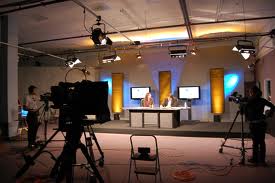
I just want to ask that you read this article and consider that I am in schools all over the state where  I am seeing first grade classrooms with smart boards where kids are constantly using and engaging with technology and even Skyping with their penpals out in California!  In a 3rd grade classroom teachers are using Edmodo to allow their students to ask questions in on online community where they can feel safe to explore subjects of their own choosing.  Fourth graders are blogging, 8th graders are a part of Good Reads and the list goes on.  Unfortunately, short of power point, I cannot think of even one technologically driven assignment that Zachary has done and our High School was built completely outfitted for such advancements.  Have you seen that television recording studio?  Why aren’t students creating TV shows that talk about the impact of biology in their community…just a thought!
Image
I would expect A’s of Zachary and beyond because he is smart and he gets things easily.  You would only expect B’s.  How sad.  Shouldn’t we expect A’s from all of our students and help them get to A’s if they are not there??  The problem lies on many levels though.  He IS motivated and organized when he is invested in something.  School is out of touch for him and for many around him.  And while the prospect of learning biology through a video game might seem outlandish, I can tell you that when there is even the slightest hint of using technology in an assignment Zachary is all over it.  He spends hours taking and editing his own videos.  What if he could “create” something to show his learning to replace an assign and test kind of teaching?  Can you imagine the possibilities and all we could learn from these Digital Natives?
I teach in classrooms from first grade through the graduate level and my question to myself is always the same…if they (my students) are not getting something then what can I do to help them to come to a fuller understanding?  I want thinking…not just memorization for a test that is gone the next day.  I want my students to connect and interact with what they are learning  and how what they are learning might impact who and how they are in the world.  Biology has so many implications for this kind of thinking…but right now I don’t think Zachary thinks biology has anything to do with him.
My daughter went to Phillips Exeter and she LOVED biology because they sat around and discussed biology!  She is now at Kenyon college as  a Biology major.  I wish that Zachary had an opportunity within the public schools to learn in a socratic method…but for some reason we rule that out as impossible and we stay with what we know.  Assign and test.  Assign and test.
The irony is that the technology that teachers have been given, powerschool, is one that only encourages the mentality of assign and test to get the grade.  Emphasis is SO heavily  weighted on  grades and not what is being learned.  So many of our kids are not motivated by grades anymore.   And the stories I could tell you about parents fighting with their kids over homework EVERY day!  I did that all last year.  It nearly killed me and my relationship with my son. Powerschool only added to the anxiety as we would look at the grades and he would talk about the things that had not yet been posted…the homework that he did pass in and every teacher is incredibly different in their use of Powerschool.  I stopped looking at Powerschool and am now looking at my son.

Image
This kind of constant helicopter parent monitoring is not only ruining parent child relationships, but it is also sad that it is the part of technology that teachers have been offered in a world of SO much more to be offered.  I can tell you there are parents who check powerschool hourly.  How is that creating responsible and independent learners to go out into the world?  They need to fail in order to learn, but there is very little room for risk-taking and failure of any kind for our kids.  I feel sad for them as the greatest things I ever learned in life often came from failures.  Are we afraid to let our kids fail?
And your final paragraph speaks of opportunities….and the lack of opportunities Zachary will have because the opportunities offered to him right now are so narrow.  THAT is the greatest rub of all.  It says conform to or your chances in life are well…less than stellar!  The system as is, is designed, particularly with Powerschool, to work against students.
Image
If Zach gets a 0 on a homework it takes 5 A’s for him to make that up.  The scale is heavily weighted towards failure…NOT success!  In my mind an A and an F should average to a C?  Right?  No.  In this point system it averages to an F.  There is very little room for risk taking and even less room for less than perfection.  It is a tough world for these kids to thrive in when their other worlds are so rich with color, light, movement, flexibility, technology and a fast paced life where they are connected.  Zach is unplugged at school…I only wish you could see him “plugged in” in the worlds that matter to him and that together we could find a way to light up the hallways of our schools where classrooms were interactive and students were truly engaged and not just  “getting through” this period to get to the next.
But I am a dreamer.
Please do take a moment to read this article and consider it’s implications as well as the fact that it was written in 2001….and perhaps consider dreaming alongside me and leaving the flash cards behind.
Thanks for “listening”.
Tomasen

Totally worth your 12 minutes. What ARE we preparing our kids for?

zgenesis's avatarzgenesis

Students are the future, but what’s the future for students?

To arm them with the relevant, timeless skills for our rapidly changing world, we need to revolutionize what it means to learn. Education innovators like Dr. Sugata Mitra, visiting professor at MIT; Sal Khan, founder of Khan Academy; and Dr. Catherine Lucey, Vice Dean of Education at UCSF, are redefining how we engage young minds for a creatively and technologically-advanced future. Which of these eduvators holds the key for unlocking the learning potential inside every student?

View original post

Rules of Engagement

Zachary came home from school the other day feeling pretty pleased with himself.  He had a “quiz” in chemistry (his most challenging subject that he struggles with) and reported that it was awesome.

Image  Yes, you are right on if you are picturing me standing in amazement with my mouth hanging open.

Zachary is an 11th grader in public school.  To know Zach is to see him always fixing, researching or tinkering with something be it the ski ramp in the backyard, the latest gadgets in photography or longboarding or his guitar.  He is and always has been “in motion”.  I used to joke that he came out of the womb on wheels!  I believe he is a very different person when in school.

He went on to tell me that this was a quiz where you “did” things and so he felt like he was better able to perform.  In his own words, “I am not good at memorizing, I am good at applying things.”  ImageHe explained how they had 5 different elements that they had to weigh and then do calculations in relationship to what it was they had discovered.   After each element they were to go up to the teacher and check in.  He was animated as he continued his story explaining that because he does not have a calculator he usually just borrows one from his math teacher, but because this was a pop quiz he did not have the time to go and get one.  So he decided he would do the math on his own.

Upon completing the first few problems he checked in with his teacher to discover he got them all right!!   When his teacher asked him how he did these problems Zach instructed him to turn the paper over where he found a lattice method scratched out on the back of his paper.

ImageThe teacher, according to Zachary, was amazed that he was able to do this math without a calculator.  Delighted he went back to finish the last 2 problems, but alas, he ran out of time.  He reported that he got a 70 on it, but that he was thrilled because as he stated,  “I feel like it is the first time that I actually understood something in chemistry.”

“What would happen, if, rather than focusing on teaching reading strategies, we focused instead on getting students engaged?”  Peter Johnston

This quote by Peter Johnston has had me thinking all week about the idea of engagement.  He refers to engagement in terms of reading and actually asks some hard questions about instruction in this Stenhouse blog post.  Worth the read.

http://blog.stenhouse.com/archives/2012/07/23/blogstitute-week-5-reducing-instruction-increasing-engagement/

ImageSo, the next question is what if we decided to make that same commitment across all subject areas, curriculums and grade levels?  What if the most common core standard of all that we were to work towards was engagement of ALL of our students?  What if we focused primarily on engaging our students and worked towards 100% proficiency of engagement?

This is so simple.  There I said it!  Think about it.  We can go on teaching and standing in front of the room and sharing our knowledge.  We can go on creating meaningless tests to supposedly “show” the growth of our students.  We can continue to spend millions and billions of dollars on the next magical cure that won’t work or…imagine this…we could look at our students and focus on engagement.  WHAT matters in our work if our students are not engaged?  What will they learn without engagement?

 What happened in this chemistry class?  The class where Zach admits to getting his daily naps because he has so much trouble paying attention.  He  argues that nobody really understands what It going on.  So what turned this day into a class period filled with engagement and dare I use the term, rigor?   I believe it all started with the ability to move and use his body.  He was not sitting in a seat in the back of the room watching the minutes slowly tick by.  He was standing, walking and using his hands to “apply” what he did and did not know.  He was then able to get some immediate feedback on his work and then a little gravy in the name of praise for his ability to perform without a calculator.  This real feedback sent him back confident and hungry for more.  It was only the clock that worked against him as he told me that he knows he could have gotten the other two if he had had the time.  And even if he didn’t get them right he was ENGAGED!!

Image

If I were his teacher I would look at Zachary differently than those who used their calculators and adjust his grade accordingly.  IF the goal is engagement and ultimately understanding could it not be argued that perhaps he understood more deeply because he could perform without the calculator?  Shouldn’t he be graded on what he did know and not that the time ran out?  But I also realize that I am far from the norm and that grading is another topic for another post.

It’s like my cats, you know.  They are very finicky about their food.  It is clear when they do not like a particular kind of food because they don’t eat it!  They are not engaged in their eating.  So I don’t continue to give them the same food because I have deemed it is the best food for them, I try out different kinds of food to see what works for them to engage them in their eating. Image Why do we continue to do things we know don’t work…especially when so many of us have the vast variety of theory and knowledge that DOES work and even more importantly that engagement is something our students are starving for?


Opt Out of Testing: Do We Dare to Bubble Dot That?

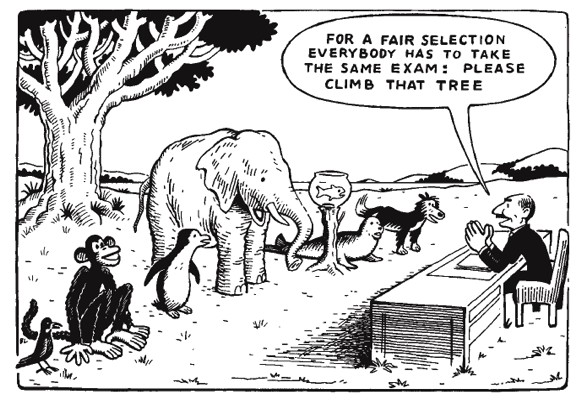
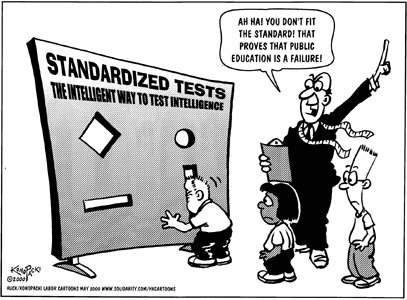
Well, the time has come for me to unleash the beast inside and ask you to look at, for yourself, your kids and your community the idea of opting out of High Stakes Testing.  Up until last week I have steered clear of writing about The Common Core State Standards and the test that will follow and how I have seen the rise of testing in our schools over the past 11 years (thank you No Child Left Behind)  has actually undermined and even damaged the education students are receiving by attempting to create a “one size fits all” mentality and leaving systems, professionals and teachers feeling they “MUST” teach to the test. Period.

one_size_fits_all_sticker-p217558662557834777en8ct_325

Recently Frontline asked three educational reform leaders including Diane Ravitch, Margaret Spellings and Geoffrey Canada  to watch and then speak back to The Education of Michelle Rhee, former chancellor of the DC public schools and a highly controversial figure in educational reform.

http://www.pbs.org/wgbh/pages/frontline/education/education-of-michelle-rhee/how-do-you-measure-success-in-school-reform/#seg3

Margaret Spellings, former US Secretary of Education under George W. Bush and one of the architects of No Child Left Behind writes in response to Rhee’s work and the upcoming onslaught of the Common Core,

“But I still argue that NCLB’s ambition remains pretty modest – all children performing at grade level in reading and mathematics – the bare minimum any of us would want for our own children or grandchildren. And while having every student meet the new Common Core standards is a laudable goal for DCPS and all the states now pursuing “college and career readiness,” it is an empty promise if they’ve yet to meet NCLB’s more modest goals.”

And I shudder to think that if a proponent of No Child Left Behind believes that even those goals were moderate then perhaps what lies ahead may be more daunting that we even realize.

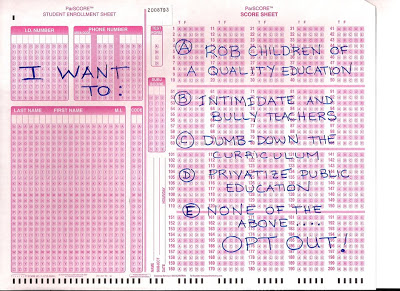
none of the above

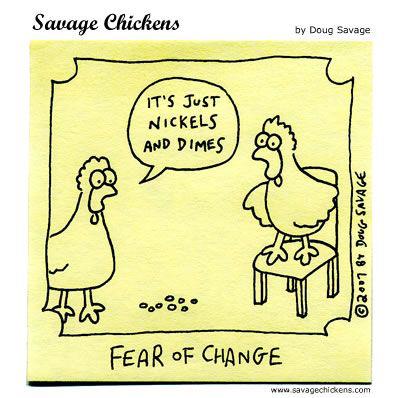
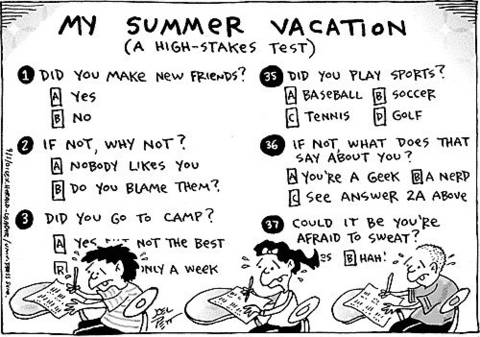
The question is do we dare?  Do we dare go against the norm or is the fear of change and going against the norm too much to risk?  Do we fear that by taking our own kids out of the testing world that it will somehow put them in a place of less importance than those who do test?  Will it limit their options in terms of lifelong goals, colleges and careers?  Without “measuring” our kids and putting them into little boxes will they become less significant in this world?  Without their numbers pasted on their backs will they matter as much as those with numbers or even more importantly those with the highest numbers?

734787_10151059810779649_1253315865_n

What does it mean to opt out?  Opting out is defined by United Opt Out National, in three phases, the first of which is to change the public narrative that testing is good.   These are the questions I am attempting to raise here.  The second is to break the cycle of complicity, isolation, coercion and the third is to support alternatives through knowledge, collaboration and trust in the power of collaboration.  I do believe that if we come together we can make a difference.  For more details about opting out…

Check out this site that talks about what it means to opt out and how we can band together to do so.  http://unitedoptout.com/flyers/what-does-it-mean-to-opt-out-2/

Or watch this video by Peggy Robertson, one of the founders of opt out, http://www.youtube.com/watch?v=_bJlbkxnDVU where she and her two boys reach out to Diane Ravitch,historian of education at New York University and expert on school reform to join them in the national opt out campaign in DC this coming April 4 – 7 where we will unite to protest against testing.  I am considering making this journey and would love to have others I know come with me or meet me there!!  You interested?  Here are more details.

http://unitedoptout.com/update-for-occupy-doe-2-0-the-battle-for-public-schools/

OptOut

So it is time for action.  Enough kavetching about it…it is time for action and trusting in the process of collaboration and the idea that if we band together we can make change happen.  REAL change for all of our kids.

What do you think?

Do we dare?

The Not So Common Core Standards: Potential Implications and Meaning For Us All

We live in a country that was founded on differences.  As I write this, I recall images of Felix Baumgartner free falling out of a hot air balloon from space.  We value this ingenuity, this creativity, this originality, this risk-taking. We live in the land of the free and yet everywhere you look, particularly in public education, it would seem we have collectively handed over our freedom in the name of compliance, consistency and the oh so not “common”, known as The Common Core.

Image

The powerful noblemen have doled out their marching orders to us, the commoners and we had better comply or beware.  David Coleman and Susan Pimenthal, co-authors of the Common Core Standards, are not educators.  They have not spent time in classrooms on the front lines and yet they have determined the core, the central, innermost, or most essential part of education.  So the question is…what does this mean for the public education of our students, your kids, my kids and those of the future?

The Common Core Standards document initially reads as somewhat benign.  Who would argue the idea that there “should” be a core of standards that all students in this great nation strive for?  (Although I tend to avoid “shoulding”on myself at all costs)  How could one oppose standards, ensuring success for all students?  (I mean if over 40 states adopted this then it must be great.)   Who would dare even oppose such a notion?  (And if you do oppose then what is wrong with you to be such a “curmudgeon” or a “whiner”.)  At the risk of being both I will go on.

Image

Read this kindergarten standard keeping in mind many 5 year olds show up to school and they do not even know their letters and they are beginning to lose their baby teeth.   For some they have never even attended preschool and this is their first school experience.  They are filled with wonder, curiosity, creativity and a natural desire to learn.

CCSS.ELA-Literacy.W.K.1 Use a combination of drawing, dictating, and writing to compose opinion pieces in which they tell a reader the topic or the name of the book they are writing about and state an opinion or preference about the topic or book (e.g., My favorite book is…).

I would argue that this is a more realistic standard for our 1st or 2nd graders.  Do we want our students to succeed or do we want to set standards that are so out of their range of normal development that they fail even before they begin?

And while I realize there ARE 5 year olds all over the nation who are more than capable of performing this standard, there are just as many who are not.  There is nothing magical about being 5 that means you are as developed as the other 5 year olds sitting next to you, not to mention that our boys are typically at least 6 months behind our girls.  And if this standard was something to look at in terms of a goal to work towards, I would have no problem with it, but it will not.  It will be seen as what is expected as “common” for all students.  We are starting out leaving over half of our kids behind.

There is no such thing as kindergarten anymore with these standards.  Sorry kids, no time to learn your letters, learn through play and be 5 years old as the standards expect you to show up to school reading informational texts closely and writing persuasive essays already.  Put away the sand tables and the blocks and the dramatic play areas there is work to be done.  And this begs the question, why are we so concerned with the academic side of the child without including the social and emotional sides?  They all work in connection with each other and without each given it’s due the scales are tipped toward disaster.

Image

The Common Core standards alone are not  bad.  In fact, in my work with schools there are great conversations that are happening as a result of this document as it asks us to look at where we are and what we are doing and what areas we need to improve on.  This is all good reflective practice and if it started and ended there…we would be able to say to ourselves, “This too shall pass”.  But will it?  Never before in public education has there been such a broad sweeping, nationally accepted document.  And while states all over the nation are adopting this document, two groups are being paid millions of dollars to come up with the best assessments (See PARCC (http://www.parcconline.org/achieving-common-core) and Smarter Balanced at (http://www.smarterbalanced.org/)).

Image

And therein lies the rub.  The high stakes testing piece to this latest “one size fits all” movement will come out in the year 2014 and I am predicting that at this point everything will change.  Schools all over the nation will be failing these tests and large publishing companies will be at their doors with the next magic bullet that will “solve” all testing deficiencies.  Have we learned nothing from No Child Left Behind?  The idea of “teaching to the test” will take on more power and energy than ever.

Image

This is not about good education.  This is not about educating our kids.  This is about making money and in order for that to happen we must first create an enormous problem.  Failure is the best reason for anyone to buy anything!  Overweight?  Buy this pill or that diet.  Failing schools?  Don’t leave it up the professionals within the schools to figure out what they need, because publishers know so much more. Students?  Who are they?

Image

We need to return to conversations about our students and what is or is not developmentally appropriate, what our students need for instruction in the moment based on their thinking, their questions and how they see the world.  Would you ever take an infant and force them to “walk” down the stairs?  NO!  But physical development is something concrete.  Cognitive development, on the other hand, is harder to understand and yet we forge ahead with the idea that if we place unrealistic expectations on our students then they will just rise.

They will not rise unless they are ready to rise!!  Those who are not ready will fall and hurdle  to the bottom of the stairs with nobody with be there to pick them up as there is a test to teach to and quite frankly, “I don’t give a  sh!t what you think or feel.”  This is a quote from David Coleman, one of 2 co-authors of the Common Core.   He has also taken on the position as head of The College Board 2 months ago.  This organization has more power over the future of all of our students and now this man will also align the SAT’s and test preps with ‘HIS” common core.  There is even talk of test scores being attached to kids GPA’s.  Can you say conflict of interest?

Image

Why and how, I must ask, have we allowed one elitist man from Harvard to have so much power over our entire system?    A man, who only cares about what he thinks.  Watch him as he demonstrates his version of a close reading on YouTube (http://www.youtube.com/watch?v=aTCiQVCpdQc) with A Letter From Birmingham Jail.  Or don’t, unless you really need a nap!  THIS is the future model for good teaching?  He is completely in his own head and unaware of his audience.  This demonstration both scares and depresses me.

And yet, why is it that those of us in education are the first ones to jump on to any wagon that happens to be going by, regardless of what band is playing?  Where has our responsibility to question gone?  Why are we not asking about what band is playing?   Why are we blindly following the pack? Let’s question what is happening here before it is too late.  Let’s take a risk, jump out of that balloon and take the plunge toward thinking and questioning what this means for our kids, our teachers and the future of our entire public educational system.

PS In my next post I will discuss some ways we can become actively involved as I discuss opting out of testing and events we can attend to show our support.